
The Challenge
Manifold valve count is frequently specified from habit or from what was used last time, rather than from what the connected instrument and process actually require. Under-specifying a manifold can compromise safe isolation or calibration; over-specifying adds unnecessary cost and installation complexity.
Technical Breakdown
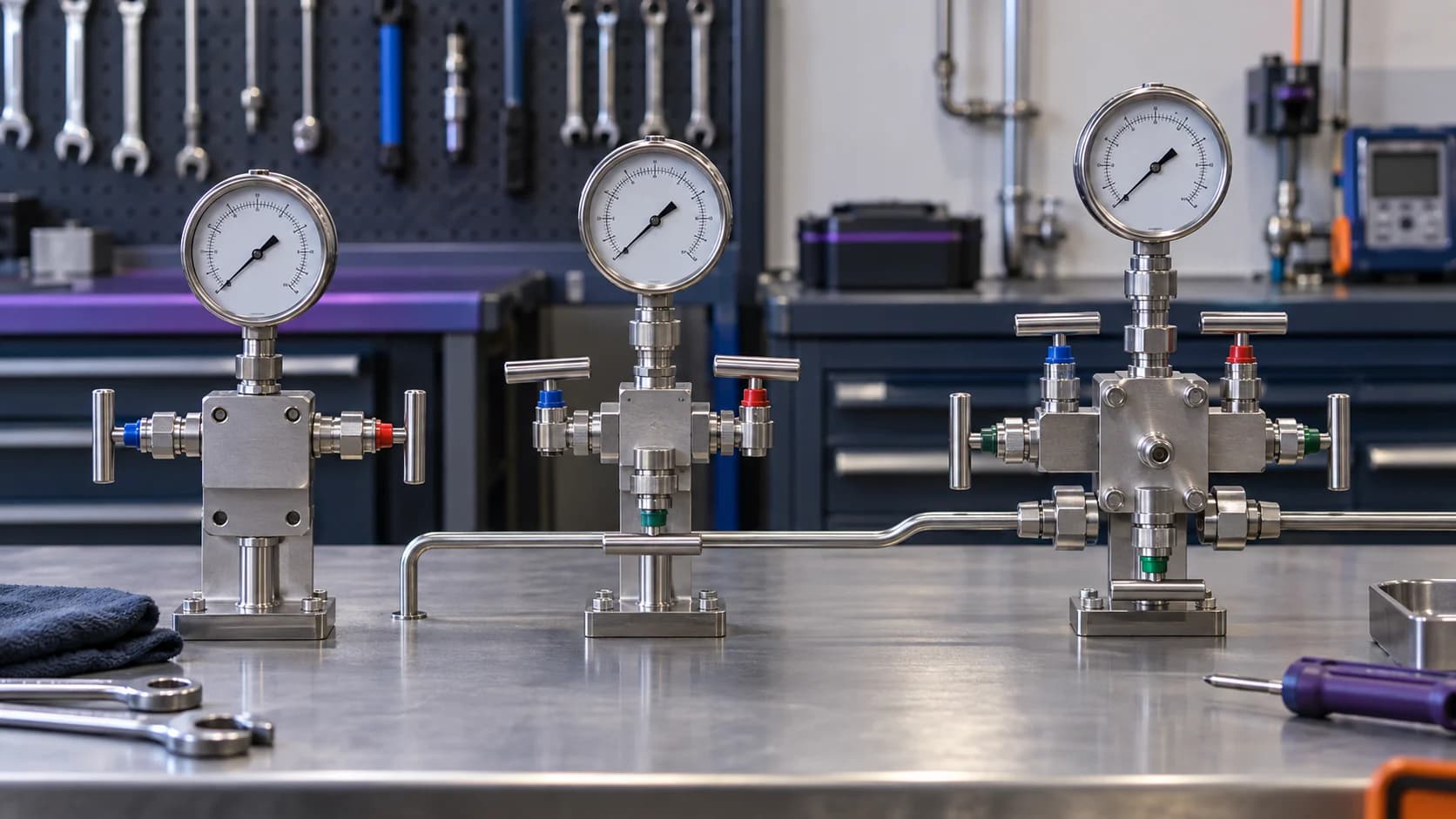
2-valve manifolds provide block-and-bleed isolation and are typically used with pressure transmitters on single-sided (gauge) measurement, where there's no need to equalise across a differential element.
3-valve manifolds add an equalising valve and are the standard choice for differential pressure transmitters — the equalising function protects the DP cell from an overrange condition during startup, shutdown or isolation by allowing pressure to be equalised across both sides before either block valve is closed.
5-valve manifolds add a second vent/bleed valve, allowing both high and low sides of a DP transmitter to be independently vented for calibration or maintenance without removing the instrument — the preferred configuration where in-situ calibration or more rigorous isolation practice is required.
Process safety classification matters directly: manifold configuration is not purely a convenience choice where isolation philosophy, lockout/tagout practice or SIL-rated loops are involved — those requirements can dictate valve count independent of instrument type.
Material and pressure/temperature rating need to match the manifold to the same duty as the tubing and instrument it serves — a manifold is a pressure-boundary component, not just a mounting convenience.
Engineering / Procurement Checklist
What to define before requesting a quotation.
- Instrument type: gauge/absolute pressure vs. differential pressure
- Isolation and equalisation requirements during startup/shutdown
- In-situ calibration requirement (drives 5-valve vs. 3-valve selection)
- Process safety/SIL classification of the measurement loop, if applicable
- Pressure/temperature rating and material matched to the connected tubing